viernes, 13 de marzo de 2026

9. EXAM ABOUT ALL TOPICS

 Friday,  13th of Maarch 2026


Hello my dears students, today is the day to show how much you´ve learned in English class.  I hope you can demostrate all your knowledge.


Good luck!


jueves, 12 de marzo de 2026

10. PAST PERFECT

 Thursday, 12th of March 2026


Good morning my dears students, today we are going to review Past Perfect.

Before starting the class, we will take the scheduled exam on what we have covered up to today.


WORKSHOP


8. MEANS OF TRANSPORTATION (VOCABULARY)

 Thursday, 12th of March 2026


Good morning my dears students, today we are goint to learn about "Means of transportation" here review vocabulary. 

Before starting the class, we will take the scheduled exam on what we have covered up to today


We are going to learn throught a game called "bingo"


8. MEANS OF TRANSPORTATION (VOCABULARY)

 Thursday, 12th of March 2026


Good morning my dears students, today we are goint to learn about "Means of transportation" here review vocabulary. 

Before starting the class, we will take the scheduled exam on what we have covered up to today


We are going to learn throught a game called "bingo"


miércoles, 11 de marzo de 2026

6- THE FAMILY - CONTINUACIÓN.


Hello my beautiful students👼


The family


March 11th
Resuelve la siguiente guía y practica


Aprendamos jugando


Tarea para el miércoles 18 de marzo
Examen del tema the family


Happy day my beautiful students

martes, 10 de marzo de 2026

9. GAME ABOUT IRREGULAR VERBS

 Tuesday, 10 of March 2026


Hello my dear students, today we are going to play  a game called "bingo", this game consist that  in pairs will have a card that have irregular verbs (infinite and past). When a word is taken from the bag, the student must cover on their  word card if they have one. 

This activity serves to reinforce and review irregular verbs in English, Which will be a topic of assessment for the exams.


lunes, 9 de marzo de 2026

6- THE FAMILY - CONTINUACIÓN.


Hello my beautiful students👼


The family


Recordemos los miembros de la familia👀


March 9th
Resuelve la siguiente guía y practica


Aprendamos jugando


Tarea para el lunes 16 de marzo
Examen del tema the family


Happy day my beautiful students

4- THE FAMILY.


Hello my beautiful students👼


The family


Presta atención👀


March 9th
My family
💚Dibuja a tu familia


Happy day my beautiful students

viernes, 6 de marzo de 2026

7. PRESENT CONTINUOUS (REVIEW)

 Friday, 06th of March, 2026


Hello my dears students, how are you today?

In this moment  I have some questions about what they did in the morning before coming to school

and then we review what we saw the previous class


7. VERB TO BE IN PAST (REVIEW)

 Friday, 06th of March, 2026


Hello my dears students, how are you today?

In this moment  I have some questions about what they did in the morning before coming to school

and then we review what we saw the previous class


jueves, 5 de marzo de 2026

6. VERB TO IN PAST

 Thursday, 05 March of 2026


Hello my dears students, today we are going to learn about verb to be in past


The past tense of the verb ‘to be’ is ‘was’ for singular subjects (I, he, she, it) and ‘were’ for plural subjects (you, we, they). These forms describe actions or states in the past.

For first person singular and third person singular, use the word was. In all other cases, use were.

For example:

  • She was a student.
  • They were doctors.

Asking question with the verb “to be” in past

In order to ask a question, was/were needs to be at the beginning of the sentence:

  • Was she a student?
  • Were they doctors?

Using the negative form of “to be” in past simple

In negative sentences, add the adverb not and put it before the word was/were.

Remember that most of the time the contraction (shortened form) is used in negative sentences: wasn’t = was not/weren’t = were not.

  • He wasn’t at the cinema with us.
  • We weren’t at home on Sunday.
  • wasn’t hungry.

1. Fill in the blanks with "was" or "were"
  • I ______ at school yesterday.
  • They ______ very happy.
  • She ______ not at home last night.
  • ______ you tired after the match?
  • It ______ a sunny day.
2. Make the sentences negative
  • Example: We were at the park. -> We weren't at the park.
  • He was my teacher. -> _________________________
  • They were friends. -> _________________________
3. Convert to questions
  • Example: She was cold. -> Was she cold?
  • They were in London. -> _________________________
  • I was right. -> _________________________


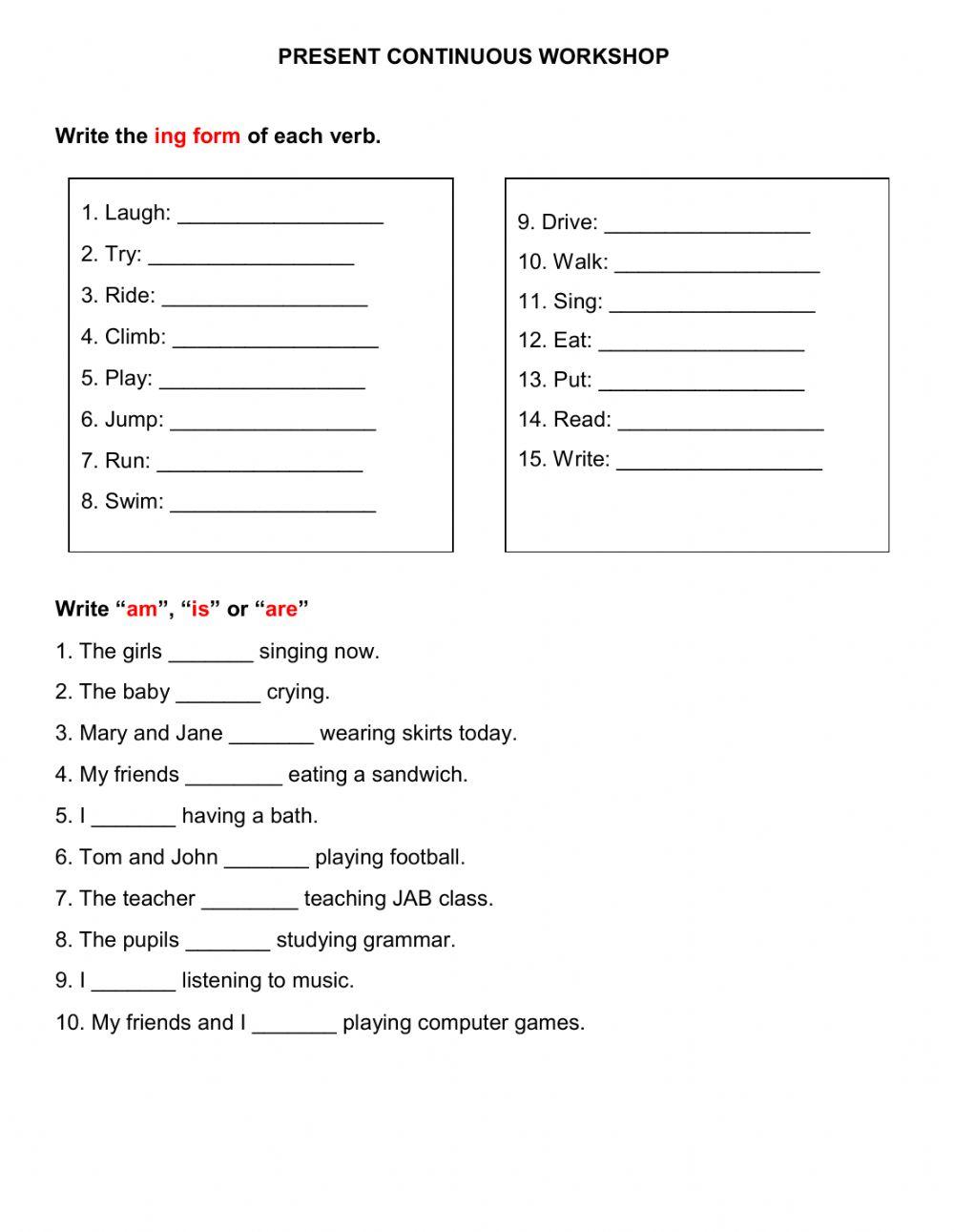
6. PRESENT CONTINOUS

 Thursday, 05 March of 2026


Hello my dears students, today we are going to learn about present continuous


The present continuous tense expresses actions happening right now, temporary situations, or future plans, formed by subject + be (am/is/are) + verb-ing. It is used for immediate actions ("She is reading"), ongoing trends ("People are changing"), and fixed arrangements ("We're meeting tomorrow").

Key Grammar Rules & Structures
  • Positive: Subject + am/is/are + verb-ing (e.g., I am working).
  • Negative: Subject + am/is/are + not + verb-ing (e.g., She is not eating).
  • Question: Am/Is/Are + subject + verb-ing? (e.g., Are they coming?).
  • Spelling Rules for -ing:
    • Most verbs: Add -ing (e.g., work 
       working).
    • Verbs ending in -e: Drop -e, add -ing (e.g., write 
       writing).
    • Verbs ending consonant-vowel-consonant: Double final consonant, add -ing (e.g., sit 
       sitting)

    • Usage Scenarios
      • Actions happening now: "I'm watching TV".
      • Temporary situations/trends: "I'm staying with a friend this week".
      • Definite future plans: "We're flying to Paris on Monday".
      • Repetitive actions (with "always/constantly"): "They are always complaining".

    • Common Mistakes & Notes
      • Stative Verbs: Generally, state verbs (e.g., know, understand, love, believe, need) are not used in continuous forms (e.g., say "I know," not "I am knowing").
      • Contractions: In conversation, contractions are common (e.g., I'm, you're, he's, she's, we're, they're)


8. PAST PERFECT

 Thursday, 05 March of 2026


Hello my dears students, today we are going to learn about past perfect


USES

1. El pasado perfecto se usa para referirse a una acción que ocurrió en el pasado antes que otra. En este caso, la primera acción se conjuga en past perfect, mientras que la segunda, la más reciente, en pasado simple. Por ejemplo

I had watched the movie before I read the book (Vi la película antes de leer el libro).

2. Sirve para hablar de una acción que ocurrió antes de un tiempo específico en el pasado. Por ejemplo:

I had fallen asleep when the clock rang at 11 PM (Ya me había dormido cuando la alarma sonó a las 11 PM).

  1. Se utiliza para hablar de acciones que iniciaron en el pasado y continuaron hasta un tiempo determinado también en el pasado. Por ejemplo:

I had been happy in all my jobs until I got this one (Había sido feliz en todos mis trabajos hasta que entré a este).

4. Es útil para el reporte indirecto con el fin de reutilizar lo dicho por una persona cuando esta habló en presente perfecto. Por ejemplo:

I have started a new degree →She said she had started a new degree (Empecé una nueva carrera → Ella dijo que empezó una nueva carrera).

  1. En algunas situaciones, se puede utilizar en oraciones condicionales. Por ejemplo:

If you had told me before, I would have helped you (Si me hubieras dicho antes, yo te hubiera ayudado).


EXERCISES

1. Alex ________________ (not/travel) alone before his trip to london

2. I _________________ (be) at home all day. I had to get out and go for a walk

3. She ____________________ (teach) Shakespeare before

4. We _________________ (not/finish) the document when the computer crased

5. She ________________ (prepare) dinner before leaving for work that day


miércoles, 4 de marzo de 2026

5. THE FAMILY.


Hello my beautiful students👼


The family

Aprendamos los miembros de la familia presta atención👀


Escribe lo siguiente:

March 4th

Father: papá
Mother: mamá
Brother: hermano
Sister: hermana
Grandfather: abuelo
Grandmother: abuela
Uncle: tío
Aunt: tía


Dibuja los miembros de la familia y escribe sus nombres correspondiente


Nota: si no alcanzaste a terminar en clase debes hacerlo en casa


Happy day my beautiful students